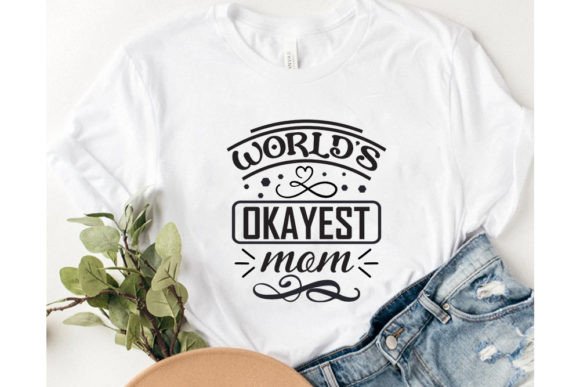
“World’s Okayest Mom” – An Embroidery Designer’s Honest Review
When I first opened the World’s Okayest Mom design file, I’ll admit I smiled. There is something instantly disarming about that phrase – it walks the line between self-deprecating humor and quiet confidence. As someone who has digitized, stitched, and sold hundreds of embroidery designs over the years, I’ve learned that the best projects are the ones that make people feel something. This one lands with a knowing wink.
The design arrives as part of a standard digital download – you get the vector files you would expect from a well-prepared Graphics package, including formats that translate nicely into most machine embroidery design workflows. Right away, I could see this working across a broad range of projects, from custom apparel to handmade product lines. The layout is clean, the lettering carries a casual but intentional feel, and the overall mood is approachable without being sloppy. That matters when you are stitching something for a paying customer or gifting it to a friend who will actually wear it.
First Stitch Impressions: Mood, Layout, and Visual Personality
The phrase “World’s Okayest Mom” has a conversational rhythm that translates well into thread. The spacing between letters feels natural, and the word “Okayest” carries the punchline. From a design perspective, the shape is relatively compact – it does not sprawl awkwardly across a garment, and it reads clearly at a glance. That is critical for any embroidery project where you want the message to land without the viewer having to squint or tilt their head.
The visual personality sits somewhere between playful and warm. It is not trying to be overly sentimental, and it is not trying to be edgy. It simply owns the moment. That makes it versatile. I could see this on a sweatshirt embroidery piece for a mom who genuinely laughs at her own parenting chaos, or on a tote bag design as a quick conversation starter at the grocery store. The design does not fight for attention – it earns it with a quiet smirk.
Because the layout relies on text rather than complex shapes or dense decorative elements, it works well as a standalone statement. There is no background clutter, no unnecessary flourishes. That simplicity is a strength when you are stitching onto fabric that already has texture or pattern. It also means the design can scale reasonably well, though I always recommend testing hoop size before committing to a final placement.
Real-World Embroidery Performance: Where This Design Shines
I tested World’s Okayest Mom on several different substrates to see how it behaved under the needle. On a mid-weight cotton sweatshirt, the lettering stitched out cleanly with good definition. The satin stitch areas held their shape, and the fill stitch sections (where the design uses broader coverage) did not pucker or shift. That tells me the original digitizing took into account the natural give of knit fabrics.
On a structured embroidered patch backing, the design held its integrity beautifully. The edges remained crisp, and there was no distortion even after trimming and sealing the patch border. That is a good sign for anyone who wants to offer patches as part of a craft business line or sell them on Etsy seller listings.
I also tried it on a baby embroidery project – a small onesie with a lightweight cotton bodysuit. Here, I paid close attention to stitch density. The design did not feel overly heavy or stiff, which is crucial for baby garments where comfort matters. The lettering remained legible, and the fabric did not ripple or distort. That is not always the case with text-heavy designs on delicate fabrics, so this was a reassuring result.
For commercial embroidery use – say, a small run of branded merchandise for a boutique or a local shop – this design would work well as a left-chest placement on tees or as a centered design on aprons. It is compact enough to fit within standard hoop sizes without wasting material, and the message is broad enough to appeal to a wide customer base.
Where to Use Care: Fabrics, Hoops, and Placement
No design is perfect for every surface, and World’s Okayest Mom has a few considerations worth noting. On very stretchy fabrics like lightweight jersey or ribbed knits, I would recommend using a cutaway stabilizer rather than tearaway. The lettering relies on clean lines, and any distortion during stitching will make the text look wobbly. A proper stabilizer choice is not optional here – it is essential for maintaining readability.
On dark fabrics, the design reads well as long as you choose thread colors with enough contrast. A bright white or a soft pastel stands out nicely against navy, black, or deep burgundy. Avoid using mid-tone colors that blend into the fabric – the design deserves to pop, not disappear.
For curved surfaces like caps or hats, the layout may need some adjustment. Because the phrase is horizontal and relatively wide, it can fight the natural curve of a cap crown. If you are stitching onto a structured cap, consider reducing the design width slightly or centering it carefully to avoid letter distortion at the edges. This is not a dealbreaker – I have stitched similar text on caps before – but it does require a bit of planning.
Small hoop sizes (4x4 or smaller) will work if you scale the design down, but be careful with letter height. Below a certain point, the interior spaces of letters like “a,” “e,” and “o” can close up, especially with satin stitch columns. Test a scaled version on scrap fabric before committing to a finished product.
Visual Appeal, Customer Trust, and Giftability
From a buyer’s perspective, World’s Okayest Mom hits a sweet spot. It is funny without being mean, personal without being niche, and giftable without requiring deep knowledge of the recipient. I have seen similar phrases sell well at craft fairs and in small shop product listings because they tap into a shared sense of humor that many moms recognize in themselves.
When a customer sees this design on a personalized gift – whether it is a pillow cover, a tea towel, or a holiday embroidery piece – they immediately understand the tone. There is no confusion about whether the message is sincere or sarcastic. It lands exactly where it is meant to land. That clarity builds customer trust because the buyer knows exactly what they are giving and how it will be received.
For handmade presentation, the design adds a layer of personality that factory-produced items often lack. Stitching this onto a kitchen towel or a blanket gives the product a handcrafted feel that customers are willing to pay a premium for. It also photographs well for printable mockup purposes – the clean lettering shows up nicely in product photos without needing heavy editing.
Practical Designer Notes Before You Sew
Here are a few things I always do before committing a new design to production, and I recommend the same workflow for World’s Okayest Mom:
- Test on scrap fabric first. Run a sample on a fabric similar to your final product. Check for puckering, thread breaks, or shifting. Adjust stabilizer or tension if needed.
- Check thread color contrast. Hold your chosen thread colors against the actual garment fabric. What looks good in the skein may disappear on a busy or dark background.
- Review stitch density. If the design feels stiff after stitching, consider reducing density or switching to a lighter backing. This is especially important for baby embroidery or lightweight garments.
- Confirm hoop size. Make sure the design fits within your hoop with at least half an inch of clearance on all sides. Crowding the hoop edge can cause registration issues.
- Test black and white mockups. Print the design in grayscale to see how the lettering reads without color distraction. This helps catch spacing or legibility problems early.
- Compare light and dark fabric backgrounds. The same design can look dramatically different on white versus black fabric. Stitch samples on both if you plan to offer color options.
- Check licensing before selling. Since this design is part of a digital embroidery file package, verify whether commercial use is allowed for finished products. If you are an Etsy seller or run a small shop product line, you need to know the terms before listing.
Beyond the Stitch: The Design as a Business Asset
For creative entrepreneurs and apparel decorators, World’s Okayest Mom is more than just a fun phrase. It is a repeatable design that can anchor an entire product line. Pair it with coordinating quotes, offer it in multiple colors, or adapt it for different garment styles. Because the file comes in formats like SVG and EPS, you can also use it for printable mockup creation, website previews, and social media content without needing to re-digitize.
I have seen similar designs drive consistent sales for handmade shop owners who target gift-givers looking for something different. The humor is broad enough to work for Mother’s Day, birthdays, or just-because gifts. It is also the kind of design that generates word-of-mouth – when someone sees it on a friend’s tote, they often ask where it came from.
For machine embroidery businesses, having a few reliable text-based designs like this one in your catalog is smart. They are less likely to go out of style than trend-driven graphics, and they appeal to a wide demographic. This particular design fits comfortably in that category.
Final Thoughts on the Design and Its Place in Your Work
After spending time with World’s Okayest Mom, I can say it is a solid addition to any embroiderer’s library. It is not trying to be the fanciest design on the rack – it is trying to be the one people actually want to stitch and give. That is a rare quality, and it is worth paying attention to.
Whether you are preparing a batch of custom apparel for a local boutique, stitching a one-off personalized gift for a friend, or building a craft business around handmade products, this design delivers the right balance of humor and heart. It stitches well, it reads clearly, and it makes people smile. If you are looking for a reliable machine embroidery design that works across T-Shirt Designs and beyond, this one is worth a close look.
Test it on your own machine, try it on a few different fabrics, and see how it fits your workflow. My guess is you will end up stitching it more than once.